
A Landscape Earned, Not Given
Greece does not reveal itself from the road. Its finest landscapes — the gorges carved into limestone, the stone-paved kalderimi connecting mountain villages, the coastal ridges where the Aegean appears without warning — exist only underfoot. But arriving without preparation is a fast route to frustration, sunstroke, or a wrong turn on an unmarked path.
We have spent fifteen years building and restoring over 2,000 kilometres of these trails at Paths of Greece. What follows is what we tell every first-timer before they lace up their boots.
Choose Your Terrain Before You Choose Your Trail
The single most common mistake a first-timer makes is treating Greece as a single landscape. It is not. The mainland mountains and the islands are different hikes entirely — different terrain, different logistics, different risks.
The mainland — Olympus, Zagori, the Pindus range, the Peloponnese, Crete — demands solid footwear, route-finding confidence, and respect for weather that moves faster than it looks. Even in midsummer, cloud can roll in on a ridge in twenty minutes. These trails are remote and deeply rewarding.
The islands — Kythera, Sifnos, Santorini, Naxos, Skiathos and others — are the natural starting point for a first-timer. The ancient kalderimi stone paths are wide, rich in history, and forgiving. The logistics are simpler. The sea is rarely far. Begin here.


Not sure where your fitness sits? Our Trail Difficulty Guide decodes what Easy, Moderate, and Difficult actually mean on a Greek trail.
Timing Is the Decision That Shapes Everything Else
Spring (April to June) and Autumn (September to October) are the seasons Greece was made for. The temperatures are manageable, the light is extraordinary, and the villages are alive without being overrun.
Summer hiking is not impossible, but it requires discipline. Temperatures on exposed southern trails regularly exceed 38°C. We follow the Split-Day rule: walk between 6:00 AM and 11:00 AM, rest through the heat of midday, return to the trail in the late afternoon if you have the energy. Between noon and four o’clock, the sun on a Greek ridge is not uncomfortable — it is dangerous. Every year, unprepared hikers learn this the hard way.
Winter is for the experienced. Crete’s southern coast is walkable from March. The northern mountains carry snow into May, and many mountain guesthouses close entirely. The trails are beautiful and empty, but the logistics require planning that a first visit rarely allows.

For guidance on conditions across regions and seasons, read our Seasonal Hiking Guide.
Where You Are Travelling From Matters
Greece sits at a different logistical distance depending on where you start. A few things worth knowing before you book.
Travelling from the US
No visa is required for stays under 90 days. The EU’s ETIAS pre-authorisation system has been launched — a simple online process, not a visa, but worth tracking before you travel.
The time difference (Greece runs 7 hours ahead of the US East Coast) means your body will be fighting the urge to sleep through the early evening and waking in the middle of the night. Give yourself a day or two to adjust before attempting a long trail day, and use those first early mornings wisely — a slow coffee, a short walk, and an early night will serve you far better than pushing through the fatigue on an exposed ridge.
One critical difference from hiking in the US: Greece has no dedicated aerial rescue service. Rescue operations are ground-based and significantly slower than what you may be used to in a National Park. We strongly recommend taking out travel insurance that explicitly covers mountain rescue and medical evacuation — standard policies frequently exclude it, and the cost of a ground rescue operation in a remote gorge can be significant.
The emergency number is 112 — it works without a Greek SIM card, provided there is some network coverage. As a general rule, never walk alone and always have someone informed about the track you will follow.
Travelling from Europe
For European hikers, Greece feels immediately familiar — until you are on a remote ridge and realise the mountain rescue infrastructure you take for granted at home does not exist here. The helicopter rescue services that UK, Swiss, or French hikers rely on in the Alps simply do not operate in Greece. Rescue operations are ground-based, slower, and in remote areas can take significantly longer than most Europeans would expect. Plan more conservatively on distance and exposed terrain than you would at home, and we strongly recommend taking out travel insurance that explicitly covers mountain rescue and medical evacuation.
Travelling from further afield (Canada, Australia, Asia)
The logistics of reaching remote trailheads are a genuine challenge. It might be tricky to combine your multiple international flights to the ferry schedules that are seasonal, domestic flights that fill quickly in summer, and rural bus connections that are sparse. Plan your transport legs with as much care as your trail legs.
Acclimatisation to the heat is the other adjustment. Visitors from temperate climates consistently underestimate how quickly dehydration sets in on an exposed Greek trail. Carry at least 2 litres of water for a half-day trail — and always set off with a full supply rather than relying on springs along the route.

Mastering Greek Transit: Beyond the Trailhead
Reaching the start of a remote kalderimi requires navigating Greece’s distinct transit ecosystem. Information online is not always absolute, and schedules bend to the rhythm of the weather. Here is how to cross the country with the confidence of a local.
Domestic Flights
Greece is exceptionally well-connected by air. The domestic skies are highly secure and primarily served by Aegean Airlines (and its subsidiary, Olympic Air) alongside Sky Express. These carriers connect almost every corner of the country directly from Athens.
There are also highly scenic regional flights hopping between smaller airports—such as routes connecting Crete to Kasos, Karpathos, and Rhodes, or spanning from Thessaloniki down to Kefalonia. Be aware that these routes often utilize small propeller planes. While they are perhaps not the most environmentally efficient method of travel, they offer spectacular, low-altitude views of the Greek archipelago.
The Ferry Network
While major islands benefit from robust, regular maritime connections, ferry travel requires a degree of philosophical patience. Schedules are often announced late, and smaller, remote islands may not be fully integrated into online booking systems.
More importantly, the Aegean dictates the timetable. High winds can cause delays, postponements, or sudden cancellations. If a gale grounds your vessel, nothing can change it—your best approach is to surrender to the delay and turn it to your advantage. For reliable online booking and tracking across most major and minor lines, platforms like Ferryhopper are highly recommended.
Driving & Car Rentals
Major international agencies (Hertz, Sixt, Avis) operate alongside local rental companies throughout the country. While local firms often provide highly competitive rates, it is imperative to check recent reviews. Always document the interior condition and rigorously inspect the tires before signing. Additionally, Greeks predominantly drive manual cars. If you require an automatic transmission, you must request and secure it well in advance, particularly on remote islands. Note that petrol is expensive; expect prices hovering around €2.00 per liter in rural areas.
The national motorways are modern, excellent, and punctuated by frequent toll stations (ranging from €1.50 to €4.50, payable via cash or card). The countryside road network, however, is a different experience. Surfaces are generally good, but local driving habits can be aggressive. Expect drivers to overtake on double lines, tailgate, or honk to pass. Do not let this disrupt your peace—simply pull slightly to the right, let them pass, and maintain your own safety. Finally, gas stations are sparse in the deep countryside, so always plan ahead.
Buses (KTEL) & Trains
Public transit outside of major cities can be complicated. While urban centers have functional systems, rural bus service fluctuates wildly. Some islands, like Sifnos, operate superb local networks; others, like Kythera, have zero public bus service.
The national intra-regional bus syndicate is known as KTEL. It links major hubs like Athens, Patras, and Thessaloniki to almost every prefecture in the country. However, because each regional KTEL operates independently, there is no centralized booking system, and websites are frequently only available in Greek. It is improving, but navigating KTEL schedules usually requires assistance from a local.
As for the railway, Greece relies on one primary train line running north from Athens to Thessaloniki, alongside a regional network serving the northern Peloponnese. Unless you are specifically travelling the main northern corridor, the train will generally not feature in your rural hiking logistics.
The Navigation Problem Most Guides Skip Over
Greek trail signage is still inconsistent, incomplete, and — in places — actively misleading. Signs erected by one municipality use a different colour code than those erected by the next. Signs disappear. Junctions are sometimes marked, sometimes not. Online hiking apps rely on crowdsourced data that can be years out of date and, in remote areas, physically dangerous.
We know this because we have spent fifteen years correcting errors in trail databases and walking hikers off paths that apps sent them onto incorrectly. The reliable resources are: Paths of Greece’s restored and signposted trail network; and the Outdooractive app — filter specifically by Official Routes to avoid the crowdsourced data that causes problems.
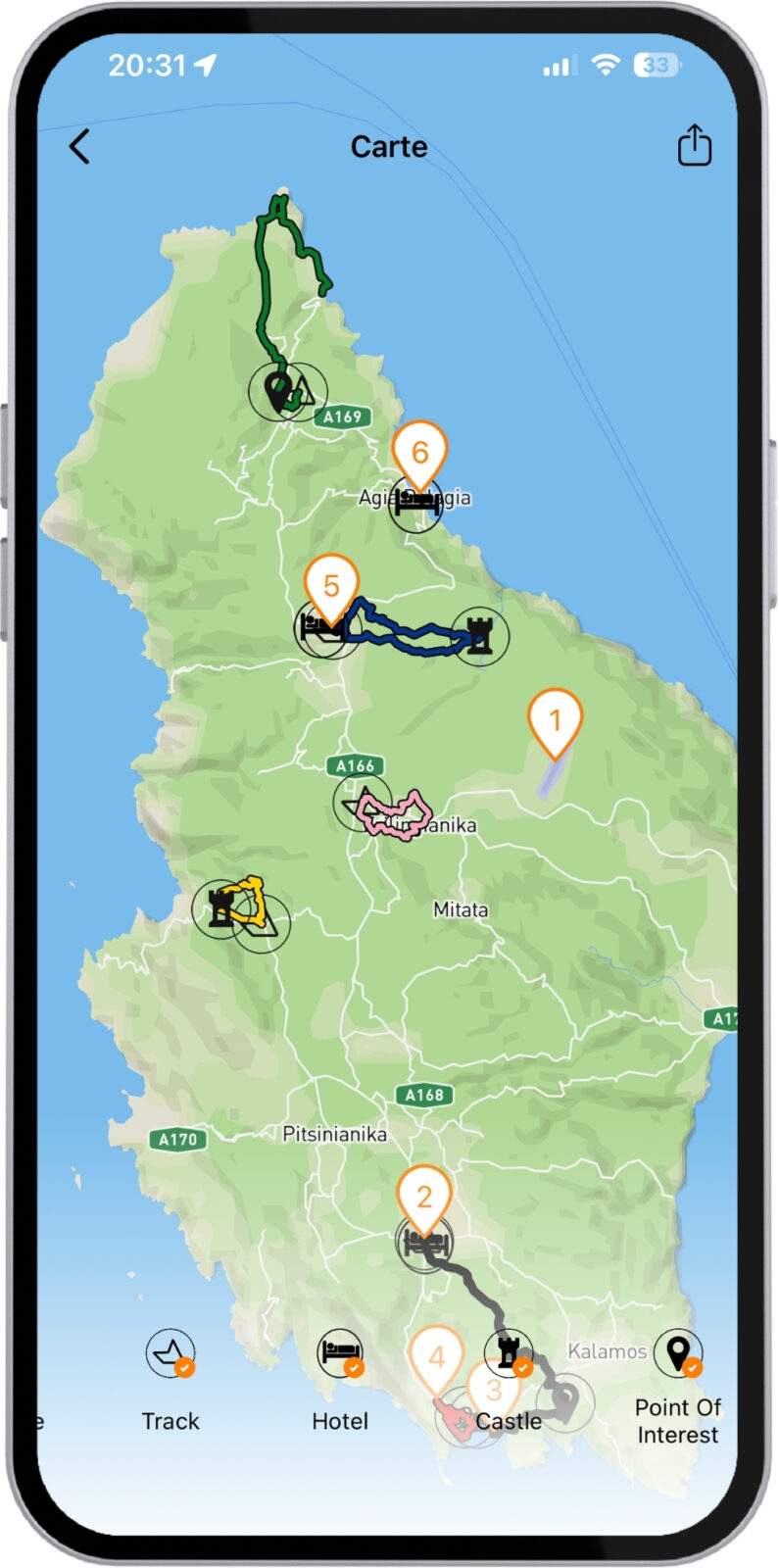
For Hike Greece tours, our Digital Trail Guide — an offline navigation tool built on the same GPS data our field teams use — will be your best companion. Always download offline maps before leaving mobile coverage. Remote gorges and high-altitude ridges have no signal.

Five Essentials Greece Specifically Requires
Most hiking checklists are generic. Here is what Greece adds:
- Ankle support, not trail runners. The kalderimi paths are beautiful but uneven. Loose scree, dry riverbeds, and sudden steep descents are standard. Match your footwear to your route.
- More water than you think. 2 litres minimum for a half-day trail. Springs exist on some routes but cannot be relied upon. Always leave full.
- Sun protection you actually use. Hat, SPF 50, UV sunglasses. Many Greek trails have no shade for hours. These are the most frequently ignored items on every group we lead.
- Download offline maps. Do this before you leave mobile coverage — do not rely on mobile data in remote areas.
- Travel insurance that explicitly covers mountain rescue. Check the small print. Standard travel policies often exclude it.
A Few Things the Trail Asks of You
Greek trails pass through working landscapes — grazing land, olive groves, active terraces. Three things matter:
- Close every gate you find closed. Livestock roam freely on many island and mountain routes.
- Do not light fires. It is illegal and dangerous across Greece from June through October due to wildfire risk. This is not a guideline — it is the law.
- When you pass through a village, slow down. Kalimera goes further than you might expect in a small community whose relationship with hiking visitors is still new.
- Wild camping is not permitted anywhere in Greece. Plan your overnight stops in advance and book accommodation before you set out.

What Hike Greece Was Built to Solve
Every obstacle described in this article — inconsistent signage, logistical complexity, unreliable app data, accommodation choices that leave you stranded near a remote trailhead — is precisely what Hike Greece was designed to eliminate. Not by packaging around the problem, but by having spent fifteen years physically fixing it.
On a guided tour, your guide is not someone who discovered these trails from a travel website. They are a field expert who knows the specific path beneath your feet — its geology, its history, its risks, its rewards. Navigation, safety, accommodation, and logistics are handled. Your only task is to walk.
On a self-guided tour, you move at your own pace, supported by our Digital Trail Guide — the same offline GPS data our field teams use — with 24/7 logistical support, luggage transfers, and hand-selected boutique guesthouses booked ahead of you. The freedom is real. The infrastructure behind it is ours.


The First Step
The ancient Greeks had a word for the feeling of being a welcome stranger in a new landscape: Philoxenia. It is the art of hospitality extended not just by people, but by a place that has been cared for. These trails have been walked for five thousand years. We have spent fifteen years ensuring they will be walked for five thousand more.
When you are ready, the paths are here.
Hike Greece is a specialized travel collective by Paths of Greece.
